The boundary
What the framework excludes
Worth saying what this does not cover, because the exclusions matter. A framework that measures everything measures nothing. Keeping the focus narrow is how the reading stays honest.
Relationships
Relationships are not a separate scored domain. Not because they do not matter.
Grief, trauma, family systems, conflict at home or at work. Any of it can shape a life more than any single lever this framework reads.
What gets read here is the measurable structural effect that relational reality produces. Sleep that breaks. A buffer eroded by legal fees. A calendar reactive after a family crisis. Attention fragmented under chronic worry.
Happiness, purpose, and meaning
Happiness and life satisfaction are not signals. They are outcomes.
A stable structure can feel miserable in a given month. A fragile one can feel fine until it breaks. Purpose and meaning work the same way: worth arguing about in philosophy, useless as a weekly stability signal.
Emotions move too fast and have too many causes. Those causes live upstream in load, sleep debt, financial pressure, or a week with no margin. Fix the structure first.
Motivation
Motivation is the exclusion most people will want to argue with, and the one the book holds the firmest line on.
Motivation is unpredictable by nature. It rises and falls on sleep, news, weather, hormones, and what someone said at a meeting yesterday. A system that depends on motivation to run is held together by a force nobody controls.
The test
If you needed to feel motivated this morning to take an action, that action was not built into the structure.
Build it into the structure and motivation becomes optional.
Discipline
Discipline gets the same treatment. It is what people reach for when structure is weak, and what good systems make unnecessary.
A person who needs a lot of discipline to keep a week from falling apart is not showing character. They are running an unstable structure on top of a limited willpower budget, and that budget will run out.
Productivity
Productivity is excluded for the cleanest reason in the set. It is output, not a root condition.
If output is getting worse, the failure lives upstream in attention, energy, or time allocation, and the reading finds it there. Tracking the surface of a problem whose source is somewhere else produces dashboards that reward looking productive.
What remains
What remains is still a lot. Body, money, and the operational machinery that runs a week. Enough to explain most of the quiet failures competent people blame on character.
Not enough to replace therapy, medicine, or a life philosophy. A narrow map keeps each failure separate and visible.
And what the book is not
The book uses specific numbers: sixty minutes for a focus block, one hundred and fifty minutes per week of moderate activity, two grams of protein per kilogram of body weight, forty percent maximum concentration in a single asset position. Each is a guideline drawn from established ranges in clinical research, sport science, behavioral economics, and financial planning practice. Each is a directional marker, not a precise rule, and the exact number that applies to your situation may differ. Your physician, dietitian, financial planner, or sleep specialist may use different values for valid reasons.
This is not medical advice, financial advice, or legal advice. A Freedom Index reading of sixty does not require a doctor. A reading of forty does not replace one. Specific symptoms, diagnosed conditions, regulatory considerations, and tax implications are outside what a structural reading can answer.
What the framework does is detect structural drift across the three domains where most quiet failures live. It reads patterns. Patterns point. Decisions remain yours.
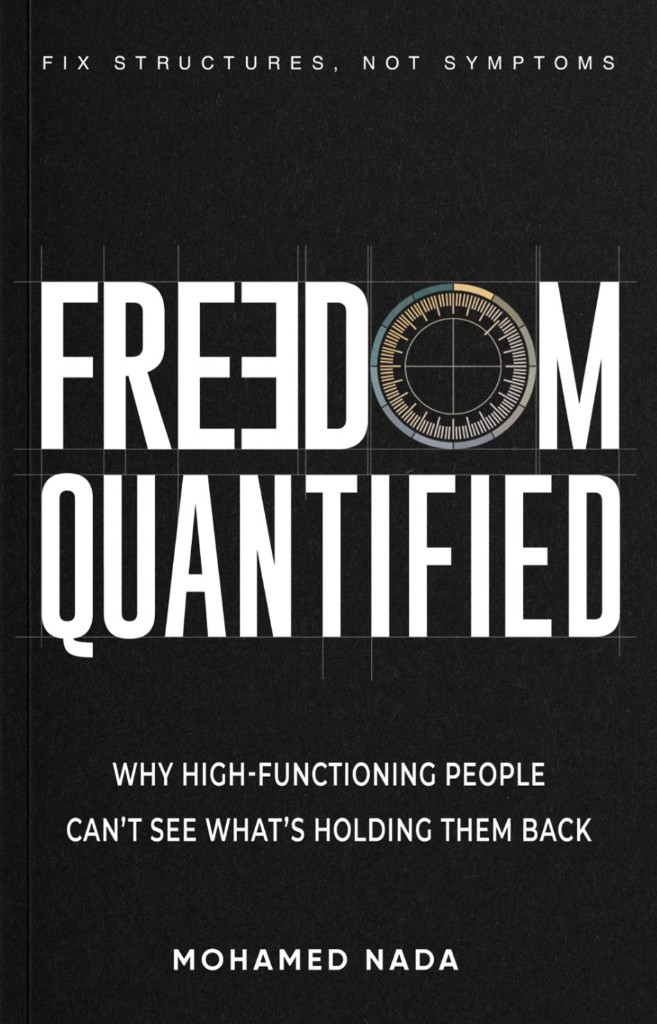
Freedom Quantified
The exclusions are set out in Chapter 3, before a single lever is introduced. That order is deliberate.
Get the book on AmazonOr see the three domains and fifteen levers that remain.