The number
The Freedom Index
It was never a question of whether your life operates as a system. It was a question of whether you could see the system while it was running.
How the number is built
Scores build up from the bottom. Lever scores combine into domain scores. Domain scores combine into one number.
Not a happiness score. Not a productivity rating. Not a wellness index that congratulates you for drinking water. One number that tells you how much of your life is sound right now and how much is quietly getting worse.
The rule that governs every level
The weakest component always stays visible. A strong score in one area cannot hide a failing score in another.
This is deliberate. Systems that let strong areas hide weak ones produce exactly the illusion that brings people to this book: everything looks fine on the surface while the structure underneath gets worse.
What the bands actually mean
82
A score of 82 does not mean you are doing well. It means 82 percent of the structural conditions required for your life to run without hidden failure are intact right now. The missing 18 percent is where something is failing.
The score does not tell you what to do. It tells you where to look.
60
A score of 60 says that multiple areas are getting worse at the same time, and the connections between them have likely already started to produce a cascade.
When the number sits at 60, a person does not need motivation. They need to find which lever is pulling the others down.
45
A score of 45 means the system is failing across enough areas that the person is almost certainly compensating with effort. Working harder, sleeping less, spending more, making faster decisions with less information.
Compensation hides the failure for a while. It does not repair it. And the effort required to stay at 45 increases over time as the failures compound.
Why the failures connect
The chapters diagnose one failure each. What none of them show, until the end, is that those failures do not exist separately.
Sleep timing instability degrades cognitive focus. Degraded focus fragments attention. Fragmented attention produces poor financial decisions. Poor financial decisions erode the buffer. An eroded buffer eliminates the margin that was supposed to protect sleep timing.
That is what a cascade looks like from the inside while it is running. No alarm. No warning. No single moment of failure. Two things going wrong at the same time, across the same months, and a third thing, judgment, quietly getting worse because of the conditions the other two are creating.
A decision can be made in eleven seconds while eleven weeks of failing structure has already decided it.
The four things it does not measure
Using a reading correctly means understanding what it leaves out.
Happiness
A person with a score of 90 can be unhappy. A person with a score of 55 can feel content. Structural stability and emotional experience are different things.
Performance and output
Achievement, ambition, results. These are outcomes. The reading measures the conditions underneath the outcomes. A person producing excellent work inside a collapsing system is borrowing from their future capacity. The reading sees that borrowing. Output numbers do not.
Effort
Two people with identical scores may be using very different levels of effort to maintain them. One maintains stability easily because the design is sound. The other maintains the same score through constant effort. A score held together by effort is fragile. A score held together by design is resilient. That difference only becomes visible when something unexpected happens.
What to do
A failing domain shows you where instability lives. The chapters tell you what that instability looks like from the inside, and what changes address the failure at the right level. The reading points. You decide.
The framework is the system. The reading is the number the framework produces.
Those exclusions are not the only ones. The framework also leaves out entire categories of life on purpose, including some that matter more than anything it measures. What the framework excludes, and why.
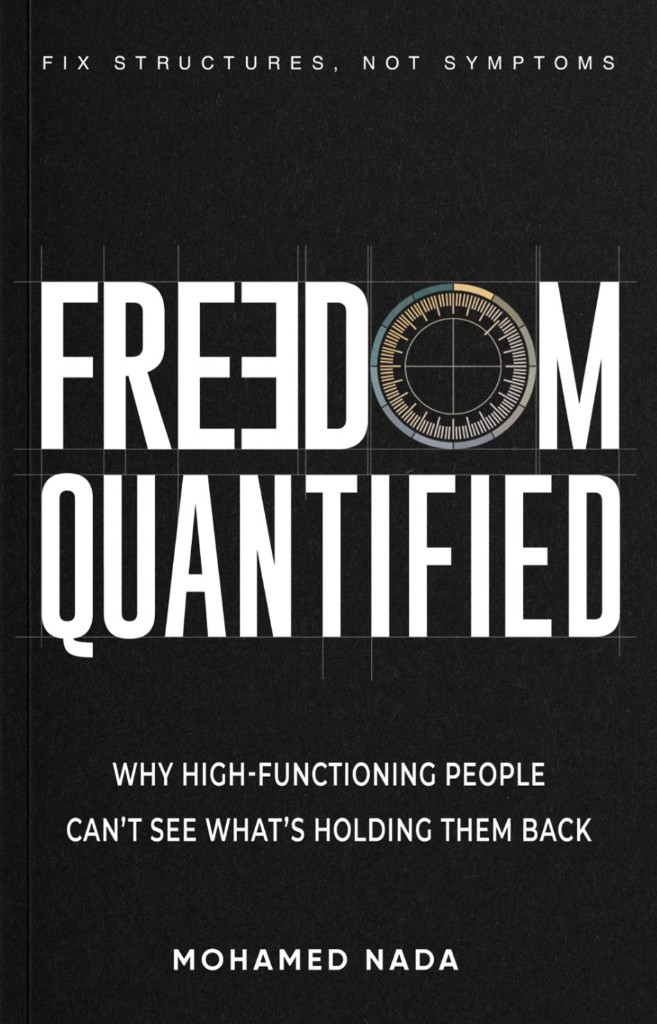
Freedom Quantified
Chapter 20 walks the full reading. It takes about thirty minutes the first time.
Get the book on AmazonOr run it by hand with the free one-page worksheet.