Before you buy
Questions readers ask
Straight answers, including the ones that will talk some people out of it. Better before the purchase than after.
What is Freedom Quantified about?
It is a structural diagnosis of why competent, capable people cannot see what is holding them back.
Three places exist where a life fails structurally: body, money, and operational capacity. Fifteen specific levers across them detect those failures. And the instruments most people already own cannot see any of it, which is why eleven straight weeks of green dashboards can precede a decision that turns out to have been made by a structure rather than a person.
The closing chapters combine the fifteen into a single reading.
Is this a self-help book?
No. It contains no motivation and no morning routine.
Motivation is in fact explicitly excluded from the framework, on the grounds that it rises and falls on sleep, news, weather, hormones, and what someone said at a meeting yesterday, so a system depending on it is held together by a force nobody controls. Discipline is excluded for the same reason: it is what people reach for when structure is weak, and what good systems make unnecessary.
The tone is diagnostic rather than encouraging.
Who is this book for, and who is it not for?
For people who are capable and running well below their capacity, who can feel that something is off but cannot locate it, and who would rather have a reading than encouragement. It assumes comfort with numbers and a willingness to score facts rather than feelings.
Not for someone in an acute crisis. The book is explicit that it does not replace therapy, medicine, or a life philosophy, and that keeping the focus narrow is how the reading stays honest.
Do I need the FREE60 app to use the framework?
No, and the book says so directly. The manual reading in the closing chapter is enough to see where the structure is failing.
A free one-page worksheet collects all fifteen levers, their diagnostic questions, and the scoring formulas. One page, no app required.
The app exists for readers who want the fifteen levers measured together and updated from signals already living in their health data, calendar, and financial systems. In the book's own words: it does not replace the book, it automates the reading the book taught you to make.
What are the fifteen levers?
Five per domain, one chapter each.
Physical capacity: sleep, load, activity, nutrition, care.
Financial capacity: expenses, liquidity, income, investments, risk.
Operational capacity: focus, priorities, schedule, buffer, routine.
How is the Freedom Index calculated?
Scores build from the bottom. Lever scores combine into domain scores, and domain scores combine into one number.
At every level the weakest component stays visible, so a strong score in one area cannot hide a failing score in another. That rule is deliberate: systems that let strong areas hide weak ones produce exactly the illusion the book is about.
A score of 82 does not mean you are doing well. It means 82 percent of the structural conditions required to run without hidden failure are intact right now, and the missing 18 percent is where something is failing. What the bands mean.
Isn't self-assessment unreliable?
The book raises this objection against itself, in the closing chapter, and calls the contradiction real.
It spends nineteen chapters arguing that your sense of your own situation is unreliable, then asks you to score yourself across fifteen levers. The answer is in how the questions are written: they ask whether something specific is true, not how you feel. Are your weekday and weekend wake times within sixty minutes of each other. Did the focus blocks you scheduled this week actually run to completion.
An answer of "I am not sure" scores closer to a 50 than an 80, because a system you cannot read is not running the way a stable one runs. More on the method.
Does the book tell me what to do?
It points rather than prescribes.
A failing domain shows where instability lives. The chapters describe what that instability looks like from the inside, and each names the change that addresses the failure at the right level.
The reading itself does not decide anything. In the closing chapter's words: the reading points, you decide.
What does the framework refuse to measure?
More than most frameworks admit to, and the reasons are set out in Chapter 3 before a single lever is introduced.
Relationships are not a separate scored domain, though their structural effects on sleep, money, load, and attention are read. Happiness, purpose, and meaning are outcomes rather than signals. Motivation and discipline are excluded because a system depending on them is unstable by construction. Productivity is excluded because it is output, not a root condition.
The reading also does not measure effort, which is why two identical scores can be held one by sound design and one by constant strain. The full set of exclusions.
Is this medical or financial advice?
No, and the book states this plainly in Methodology and Caveats.
A Freedom Index reading of sixty does not require a doctor. A reading of forty does not replace one. Specific symptoms, diagnosed conditions, regulatory considerations, and tax implications are outside what a structural reading can answer.
The numbers it uses, sixty minutes for a focus block, one hundred and fifty minutes of weekly moderate activity, forty percent maximum concentration in a single position, are directional markers drawn from established ranges in clinical research, sport science, behavioral economics, and financial planning practice. Guidelines, not precise rules. Your physician, dietitian, or financial planner may use different values for valid reasons.
How long is it, and what formats is it available in?
The first edition runs twenty chapters. The paperback is 260 pages (ISBN 979-8258939654). The Kindle edition is listed at 182 pages, which is Amazon's own estimate rather than a different text. Both published April 2026.
The one-page worksheet that runs the framework by hand is free.
Who wrote it?
Mohamed Nada, a senior leader at a global healthcare company who has spent his career building the measurement infrastructure that shows large organizations where the gaps are, not where the metrics suggest.
He spent nearly as long trying to build one for himself.
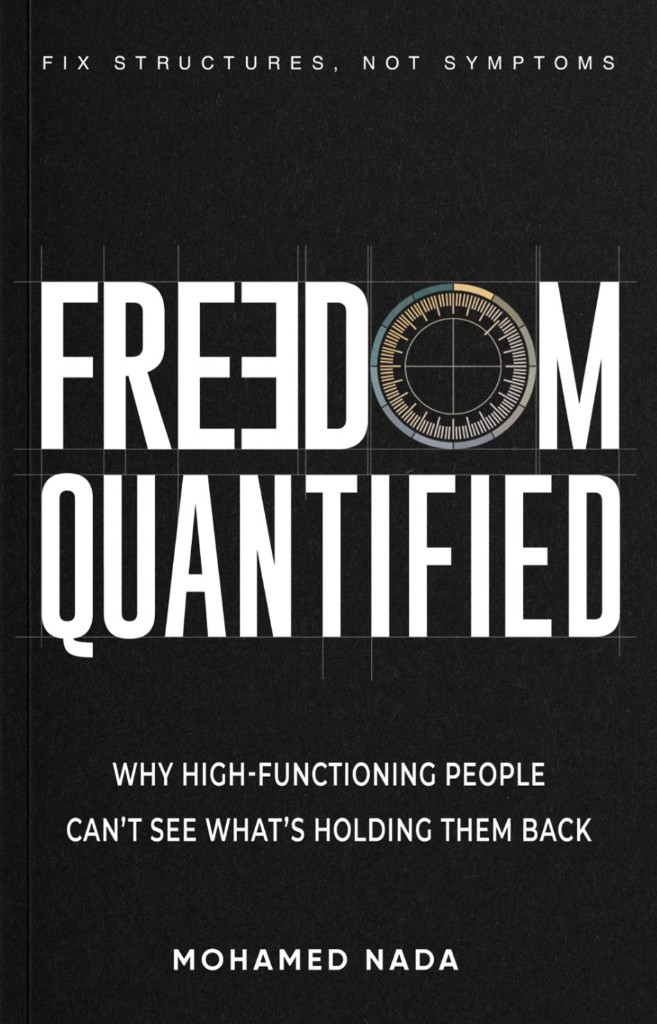
Freedom Quantified
Why high-functioning people can't see what's holding them back.
Get the book on AmazonStill deciding? Read the framework in full, free.