Contents
What is actually in this book
Twenty chapters across five parts. Three set the foundation, fifteen take one lever each, and two close by putting the fifteen back together into a single reading.
Foundation
Why the instruments you already own can read green, continuously, while the structure underneath them degrades.
- IntroductionEleven weeks of green dashboards, one decision made with total confidence, and a number six months later that turned a color the spreadsheet had never shown before.
- 1The Number That Reads Your LifeWhat a single structural reading shows that fifteen separate apps cannot.
- 2Systems Don't Care About Your WillpowerWhy a structure held together by effort fails differently from one held together by design.
- 3The Terrain of FailureThe three domains, and everything the framework deliberately leaves out.
Health
When physical systems fail, restoration does not finish. Nothing else runs cleanly.
- 4The Clock Your Body KeepsSleep. Timing, not just hours.
- 5Your Body's Strain MeterLoad. Whether strain clears faster than it accumulates.
- 6Movement Isn't ExerciseActivity. Distribution across the week, not volume on Saturday.
- 7Fuel, Not PerformanceNutrition. The protein supply line, set up once as a default.
- 8The Checkups You Keep SkippingCare. The station that produces no signal at all until it is measured.
Wealth
Money pressure does not stay in its lane. It forces bad decisions in every other domain.
- 9Where the Money Actually GoesExpenses. The moving total, which is the one thing no budget app shows.
- 10The Runway You Don't HaveLiquidity. Months of cover, calculated rather than assumed.
- 11Income Is a System, Not a NumberIncome. How many sources, and who can close each one.
- 12Money You Never DeployInvestments. Whether surplus moves on a schedule or waits on a decision.
- 13The Risks You Can't SeeRisk. What determines whether the other four survive something unexpected.
Capacity
You have the intention. You cannot convert it into consistent, structured action.
- 14Where Your Attention Actually LandsFocus. Whether attention holds long enough to finish work that needs sustained thought.
- 15The Priorities That Contradict Each OtherPriorities. Whether the commitment list is shorter than what a week can advance.
- 16The Gap Between What You Said and What You DidSchedule. Whether time flows where you said it should.
- 17How Overload Actually HappensBuffer. Whether the week can absorb one normal disruption.
- 18The Rhythm You LostRoutine. What dissolved after a disruption and never came back.
Closing
Reading the fifteen together.
- 19What High Looks LikeAn ordinary Tuesday with nothing impressive on it, described as the result of fifteen levers holding at the same time. Explicitly not a portrait to chase.
- 20Reading the NumberHow the levers combine into the Freedom Index, and how to run the reading. About thirty minutes the first time.
Back matter
- Methodology and CaveatsWhere the specific numbers come from, and the plain statement that this is not medical, financial, or legal advice.
- The Companion AppWhat the app automates, and why the manual reading is enough on its own.
- AcknowledgementsIncluding an open invitation to find the failure modes the framework missed.
- About the AuthorSee the author page.
The framework in one paragraph
Three domains. Fifteen levers across them, five per domain. Each lever detects one or more independent failure modes, each failure mode produces a signal, and together they produce a reading. Scores build from the bottom: lever scores combine into domain scores, and domain scores combine into one number. At every level the weakest component stays visible, because a system that lets strong areas hide weak ones produces exactly the illusion the book is about.
The three domains and fifteen levers in full.
Running it yourself
The book gives you the framework, and the manual reading is enough to see where the structure is failing. A free one-page worksheet collects all fifteen levers, their diagnostic questions, and the scoring formulas in one place. No app required.
FREE60 runs the same framework continuously, from signals already living in your health data, calendar, and financial systems. It does not replace the book. It automates the reading the book taught you to make.
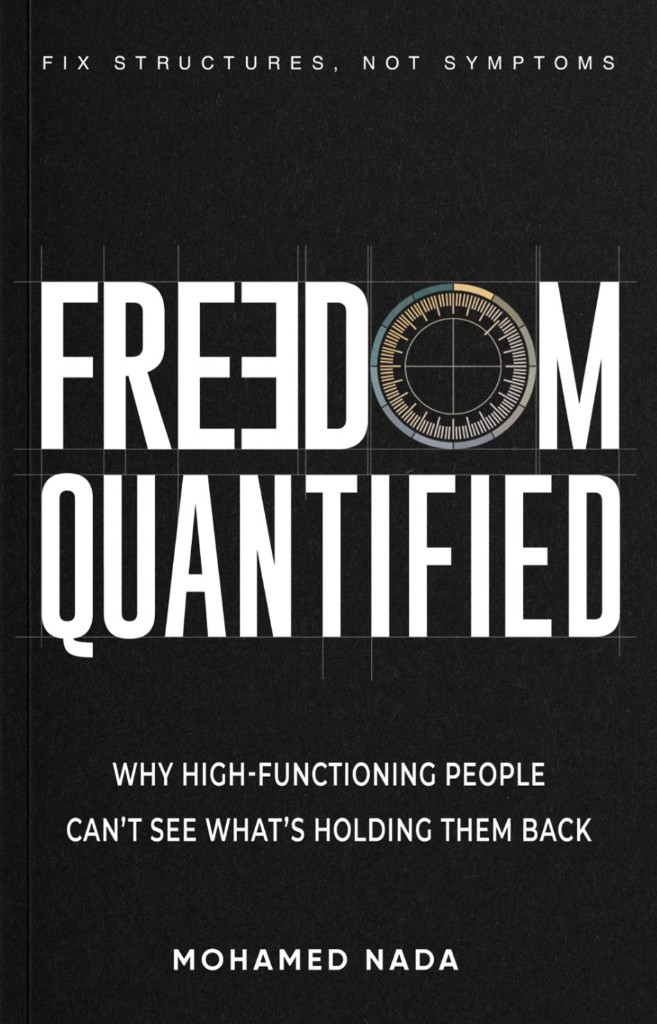
Freedom Quantified
First edition, published April 2026. 260 pages in paperback, also available on Kindle.
Get the book on AmazonOr read the framework first.